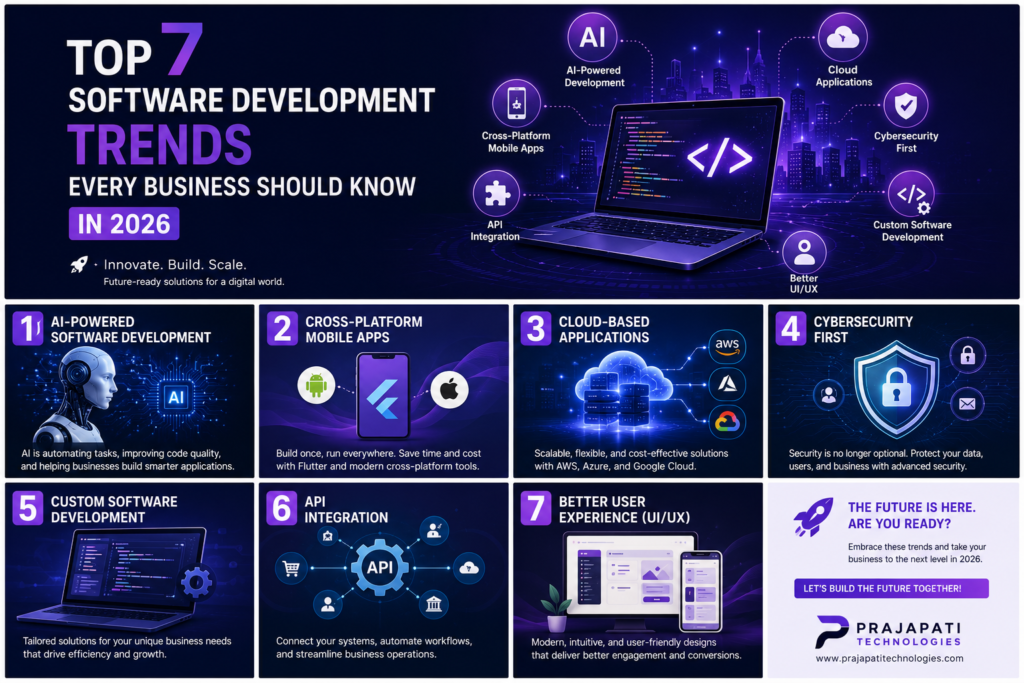
Top 7 Software Development Trends Every Business Should Know in 2026
Technology is evolving faster than ever, and businesses that fail to adapt risk falling behind. In 2026, software development is no longer just about building websites or mobile apps — it's about creating intelligent, scalable, and secure digital solutions that drive real competitive advantage.
Artificial Intelligence, cloud computing, cross-platform development, and automation are changing the way businesses operate. Whether you're a startup or a large enterprise, understanding these trends can help you make smarter technology investments — choosing solutions that will still be relevant in 3–5 years, not just today.
In this article, we'll explore the top seven software development trends every business should know in 2026 — and how you can leverage them for growth.
AI-Powered Software Development
Artificial Intelligence has become one of the biggest drivers of innovation in software development. Businesses are no longer asking "should we use AI?" — they're asking "where can AI create the most impact?" From intelligent AI chatbots that handle customer support to autonomous AI agents that execute complex business tasks, AI is transforming every layer of business operations.
Businesses are using AI to:
- Automate repetitive tasks and reduce manual work by 40–60%
- Improve customer support with intelligent chatbots available 24/7
- Generate reports, summaries, and content at scale
- Analyze data and predict trends using machine learning models
- Build AI-powered applications that learn and improve over time
Companies integrating AI through platforms like OpenAI GPT-4, Claude, and Google Gemini are reducing costs while dramatically increasing productivity and customer satisfaction.
Cross-Platform Mobile Apps
Instead of building separate Android and iOS applications — doubling development time and cost — businesses in 2026 are choosing cross-platform technologies like Flutter. A single codebase produces native-quality apps for both platforms, cutting development time by 30–40% while maintaining excellent performance.
Benefits of cross-platform development include:
- Faster development — launch on both platforms simultaneously
- Lower cost — one team, one codebase, two platforms
- Consistent user experience across all devices
- Easy maintenance — fix once, deploy everywhere
- Near-native performance with modern frameworks like Flutter
For businesses that need mobile presence without enterprise-level budgets, cross-platform is the smart choice in 2026.
Cloud-Based Applications
Cloud computing allows businesses to scale applications without investing heavily in physical infrastructure. In 2026, cloud-native architecture isn't optional — it's the default approach for any application that needs to handle growth, provide global access, and maintain high availability.
Popular cloud platforms businesses are building on:
- AWS (Amazon Web Services) — widest service range, enterprise-grade
- Google Cloud Platform — best for AI/ML and data analytics
- Microsoft Azure — ideal for Microsoft ecosystem businesses
Cloud applications offer better performance, flexibility, automatic scaling, disaster recovery, and enterprise-grade security — all without managing physical servers.
Cybersecurity First Development
As cyber threats continue to grow in sophistication, businesses in 2026 are no longer treating security as an afterthought. "Security-first" means building protection into every layer of your application from day one — not patching vulnerabilities after a breach makes headlines.
Modern secure software development includes:
- Multi-factor authentication (MFA) for all user access
- End-to-end data encryption at rest and in transit
- Secure API design with rate limiting and input validation
- Regular security audits and penetration testing
- OWASP compliance and secure coding standards
- Zero-trust architecture for enterprise systems
A secure application builds customer trust, protects valuable data, ensures regulatory compliance (GDPR, PDPA, HIPAA), and prevents costly breach incidents that average $4.5M per occurrence.
Custom Software Development
Every business has unique requirements that generic off-the-shelf software simply cannot address. In 2026, more companies are investing in custom software development because they've realized that adapting their business to fit rigid software is more expensive long-term than building software that fits their business perfectly.
Custom software provides:
- Better efficiency — built specifically for your workflows
- Workflow automation — eliminate manual processes unique to your business
- Unlimited scalability — grows with your business without licensing limits
- Competitive advantage — features your competitors don't have
- Full data ownership — no vendor lock-in or third-party data access
- Integration freedom — connects with any existing system
Unlike off-the-shelf software with monthly per-user fees that compound over time, custom solutions are a one-time investment that you own forever — with lower total cost of ownership for businesses with 20+ users.
API Integration and Connected Systems
Businesses in 2026 use dozens of tools daily — CRM, accounting, email, WhatsApp, payment gateways, ERP, marketing platforms. Without proper integration, each tool becomes a data silo requiring manual copy-paste between systems. API integration connects these systems seamlessly, creating a unified digital ecosystem.
Common API integrations businesses need:
- Payment gateways (Stripe, PayPal, Razorpay, PayNow)
- CRM software (HubSpot, Salesforce, Zoho)
- WhatsApp Business API for customer communication
- Email platforms (SendGrid, Mailchimp, AWS SES)
- ERP systems for inventory and finance
- AI services (OpenAI, Gemini) for intelligent processing
Integrated systems save 15–25 hours per week in manual data handling, reduce errors by 90%, and give management real-time visibility across all operations. Tools like n8n make complex integrations possible without custom coding for every connection.
Better User Experience (UI/UX) Design
A beautiful interface is not enough in 2026. Modern software focuses on the complete user experience — speed, accessibility, intuitiveness, and emotional design that makes users want to come back. Studies show that every $1 invested in UX returns $100 in business value through higher conversions and lower support costs.
Modern UI/UX priorities include:
- Faster loading speed — under 3 seconds (Core Web Vitals compliance)
- Mobile-first responsive design for all devices
- Intuitive navigation — users find what they need in 3 clicks or less
- Accessibility compliance (WCAG 2.1) for inclusive design
- Micro-interactions and feedback for better perceived performance
- Data-driven design decisions using heatmaps and user analytics
Good UI/UX directly leads to higher engagement, lower bounce rates, more conversions, and better customer retention — measurable business outcomes, not just aesthetics.
Why These Trends Matter for Your Business
Businesses adopting modern software development technologies in 2026 are experiencing measurable advantages over competitors who rely on outdated approaches:
- Faster operations — automated workflows complete in seconds what took hours manually
- Lower operational costs — AI and automation reduce staffing needs for repetitive work by 40–60%
- Better customer satisfaction — 24/7 AI support, faster apps, and personalized experiences
- Increased productivity — integrated systems eliminate data silos and duplicate work
- Improved scalability — cloud-native architecture handles 10x growth without rebuilding
- Higher business growth — technology-driven companies grow 2–3x faster than traditional competitors
The question isn't whether to adopt these trends — it's how quickly you can implement them before your competitors do.
Why Choose Prajapati Technologies
At Prajapati Technologies, we help businesses embrace the latest technologies and build future-ready digital solutions. We don't just follow trends — we implement them in production systems that deliver measurable business results. With 200+ projects delivered and a team of 50+ engineers, we have the expertise to turn these trends into your competitive advantage.
Our Services
We combine innovation, modern technologies, and business strategy to deliver high-quality software solutions — from initial consultation to production deployment and ongoing support.
Ready to Future-Proof Your Business?
Let's discuss how these trends can be implemented in your business to drive growth, reduce costs, and stay ahead of competition.
Get Free Technology Consultation →